Manning’s Equation is the most widely used formula for calculating flow velocity and discharge in open channels and partially full pipes. Its simplicity and accuracy have made it the standard for drainage design since the late 19th century.
History and Development
The equation is named after Robert Manning, an Irish engineer who presented his formula in 1889. However, similar formulas were developed independently by others, including Philippe-Gaspard Gauckler in 1867 and Albert Strickler in 1923. In some countries, you’ll see references to the “Gauckler-Manning” or “Manning-Strickler” equation.
The Fundamental Equation
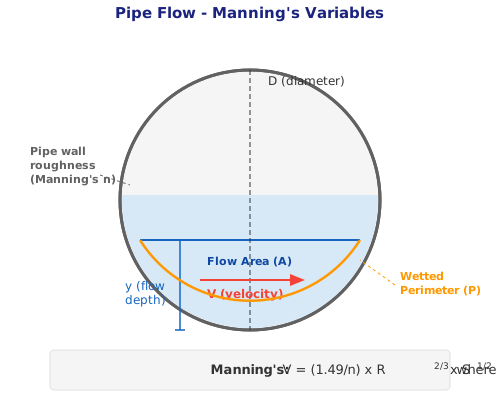
Manning’s Equation relates flow velocity to channel characteristics:
Where:
- V = Mean velocity (ft/s or m/s)
- k = Unit conversion factor (1.486 for U.S. customary, 1.0 for SI)
- n = Manning’s roughness coefficient (dimensionless)
- R = Hydraulic radius (ft or m)
- S = Channel slope (ft/ft or m/m, dimensionless)
The Discharge Form
Multiplying velocity by flow area gives discharge:
Where A is the cross-sectional flow area.
Since R = A/P (where P is wetted perimeter):
The Conversion Factor Debate: 1.486 vs 1.49
| Factor | Origin | Usage |
|---|---|---|
| 1.486 | Precise conversion from SI | Academic texts, some agencies |
| 1.49 | Rounded for practical use | Many design manuals, software |
| 1.00 | SI units (meters, seconds) | International standards |
The math:
Practical impact: Using 1.49 vs 1.486 gives a 0.27% difference—negligible compared to uncertainty in n-value selection. Most practicing engineers use 1.49.
Understanding Each Variable
Hydraulic Radius (R)
The hydraulic radius is the ratio of flow area to wetted perimeter:

Physical meaning: R represents how “efficiently” the channel section conveys flow. Larger R means less friction per unit area.
Common values:
| Channel Shape | Hydraulic Radius Formula |
|---|---|
| Full circular pipe | R = D/4 |
| Wide rectangular | R ≈ depth (if width >> depth) |
| Half-full pipe | R = D/4 (same as full!) |
Manning’s n (Roughness Coefficient)
Manning’s n characterizes the frictional resistance of the channel surface. Values typically range from 0.010 (very smooth) to 0.150 (heavily vegetated).
Factors affecting n:
- Surface roughness (material type)
- Vegetation
- Channel irregularity
- Channel alignment
- Silting and scouring
- Obstructions
- Size and shape of channel
- Stage and discharge
See complete guide: Manning’s n Selection →
Channel Slope (S)
Slope is the energy gradient, which for uniform flow equals the channel bed slope:
Common expressions:
- Decimal: 0.005 (0.5%)
- Percent: 0.5%
- Ratio: 1:200
Application to Circular Pipes
Full Pipe Flow
For a circular pipe flowing completely full:
Substituting into Manning’s equation:
Simplified:
Partial Pipe Flow
Real storm sewers rarely flow full. Partial flow analysis requires relating depth (d) to diameter (D).

The relationship is complex. At any depth ratio (d/D):
Key insight: Maximum discharge in a circular pipe occurs at about 93% full (d/D ≈ 0.93), not when completely full!
Try the Manning’s Pipe Calculator →
Application to Open Channels
Rectangular Channels
Where b = bottom width and y = flow depth.
Trapezoidal Channels
Where z = side slope (horizontal:vertical).
Triangular Channels (V-Ditches)
Try the Manning’s Channel Calculator →
Normal Depth and Critical Depth
Normal Depth
Normal depth (yn) is the depth at which uniform flow occurs for given Q, n, S, and channel geometry. Finding normal depth requires solving Manning’s equation iteratively for y.
At normal depth:
- Energy slope = bed slope
- Flow is uniform
- Velocity is constant along the channel
Critical Depth
Critical depth (yc) is where specific energy is minimum for a given discharge. At critical depth:
Where Fr is the Froude number and Dh is the hydraulic depth (A/T, where T is top width).
Flow Regime
Comparing normal depth to critical depth determines flow regime:
| Condition | Flow Type | Characteristics |
|---|---|---|
| yn > yc | Subcritical | Slow, tranquil, Fr < 1 |
| yn < yc | Supercritical | Fast, rapid, Fr > 1 |
| yn = yc | Critical | Transitional, Fr = 1 |
Step-by-Step Calculation Examples
Example 1: Pipe Capacity
Given:
- 24-inch RCP (reinforced concrete pipe)
- Slope: 0.5%
- n = 0.013 (concrete)
Find: Full pipe capacity
Solution:
-
Convert diameter: D = 24” = 2.0 ft
-
Calculate flow area:
- Calculate wetted perimeter:
- Calculate hydraulic radius:
- Apply Manning’s equation:
Verify with Manning’s Pipe Calculator →
Example 2: Channel Sizing
Given:
- Design flow: Q = 100 cfs
- Channel: Trapezoidal, 2:1 side slopes
- Slope: 0.3%
- n = 0.030 (grass-lined)
- Maximum velocity: 6 fps
Find: Required bottom width
Solution: This requires iteration. Start with assumed bottom width and adjust.
Trial 1: b = 6 ft
-
Assume depth y = 2.5 ft (will verify)
-
Calculate area:
- Calculate wetted perimeter:
- Calculate hydraulic radius:
- Calculate capacity:
Capacity is less than 100 cfs, so increase depth or width. After several iterations: b = 6 ft, y = 2.65 ft gives Q ≈ 100 cfs
- Check velocity:
Try the Manning’s Channel Calculator →
Limitations of Manning’s Equation
1. Uniform Flow Assumption
Manning’s equation strictly applies to uniform flow (constant depth and velocity). For gradually varied flow, use step methods or numerical solutions.
2. Turbulent Flow Requirement
The equation is valid for turbulent flow (Re > ~4000). For very smooth channels at low velocities, flow may be transitional.
3. Rigid Boundary Assumption
The equation assumes a fixed boundary. For movable bed channels (sand, gravel), sediment transport changes the boundary.
4. Steady Flow
Manning’s equation is for steady flow. For unsteady conditions (rising or falling hydrograph), use more sophisticated methods.
5. n-Value Uncertainty
The biggest source of error is usually n-value selection. A ±10% error in n produces a ±10% error in velocity and discharge.
The Relationship to Other Equations
Darcy-Weisbach
The Darcy-Weisbach equation is theoretically superior:
Relationship between Manning’s n and Darcy-Weisbach f:
Chezy Equation
Manning’s equation is a specific form of the Chezy equation:
Where:
Hazen-Williams (for Pressure Flow)
For full pipes under pressure, Hazen-Williams is often used instead:
Manning’s is preferred for gravity flow (open channel conditions).
Summary
Manning’s Equation is powerful because:
- Simple to apply
- Accurate for wide range of conditions
- Minimal input data required
- Widely accepted and understood
Key points to remember:
- Use appropriate conversion factor (1.49 or 1.486)
- Select n carefully—it’s the main source of error
- Applies to uniform, turbulent, steady flow
- Works for both pipes (partial flow) and open channels
- Maximum pipe flow occurs at ~93% full
References
-
Manning, R. (1891). On the flow of water in open channels and pipes. Transactions of the Institution of Civil Engineers of Ireland, 20, 161-207.
-
Chow, V. T. (1959). Open-channel hydraulics. McGraw-Hill.
-
Federal Highway Administration. (2012). Hydraulic design of highway culverts (3rd ed., Hydraulic Design Series No. 5). U.S. Department of Transportation.
-
American Society of Civil Engineers. (2007). Gravity sanitary sewer design and construction (2nd ed., ASCE Manual of Practice No. 60). ASCE Press.
-
Sturm, T. W. (2010). Open channel hydraulics (2nd ed.). McGraw-Hill.
-
Yen, B. C. (2002). Open channel flow resistance. Journal of Hydraulic Engineering, 128(1), 20-39.
Try These Calculators
Put what you've learned into practice with these free calculators.
Manning's Equation for Pipe Flow Calculator
Calculate pipe flow discharge, velocity, and hydraulic properties using Manning's equation.
Manning's Channel Calculator
Calculate open channel flow using Manning's equation.
Normal Depth Calculator
Calculate normal depth for open channels and pipes using Manning's equation.
Vegetated Swale Calculator
Calculate vegetated swale hydraulics including normal depth, velocity, and capacity using Manning's equation with variable roughness based on vegetation retardance.