A hydrograph is one of the most important tools in drainage engineering. It shows how flow rate changes over time at a specific location—telling the complete story of how a watershed responds to rainfall.
What Is a Hydrograph?
A hydrograph is a graph showing discharge (flow rate) versus time at a specific point in a watershed. While the Rational Method gives you only the peak flow, a hydrograph shows:
- When flow starts rising
- How quickly it rises
- When the peak occurs
- How long elevated flows persist
- The total volume of runoff
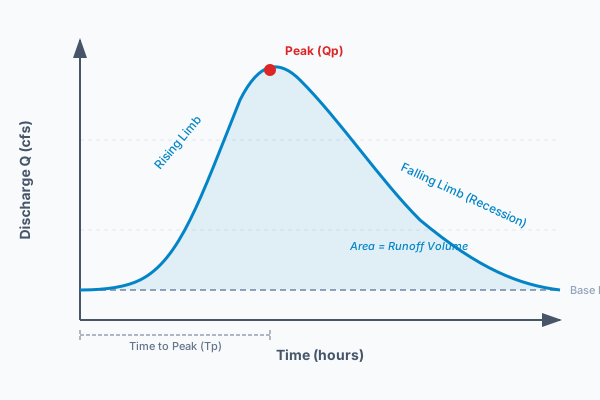
Anatomy of a Storm Hydrograph
Key Components
- Rising Limb: The portion where flow increases as the storm begins and runoff accumulates
- Peak Flow (Qp): The maximum discharge rate
- Time to Peak (Tp): Time from the start of runoff to the peak
- Falling Limb (Recession): The portion where flow decreases after the peak
- Base Flow: The background flow from groundwater, present before and after the storm
Key Timing Parameters
- Lag Time (TL): Time from center of rainfall mass to peak discharge
- Time of Concentration (Tc): Time for water to travel from the most remote point to the outlet
- Time Base (Tb): Total duration of direct runoff
Types of Hydrographs
1. Storm (Event) Hydrograph
Shows the response to a single rainfall event. This is what most drainage engineers work with for design.
Characteristics:
- Distinct peak responding to rainfall
- Volume equals total runoff from the storm
- Shape influenced by watershed characteristics
2. Annual Hydrograph
Shows flow variation over an entire year. Used for:
- Water supply planning
- Environmental flow requirements
- Seasonal flood analysis
3. Unit Hydrograph
A special theoretical hydrograph representing the response to 1 inch (or 1 cm) of excess rainfall applied uniformly over the watershed in a specific time period.
Where:
- Q(t) = Discharge at time t
- U(t) = Unit hydrograph ordinate
- Pe = Excess precipitation
Why unit hydrographs matter: They allow you to predict the hydrograph for any storm by scaling and superimposing responses.
Learn more: SCS Unit Hydrograph Calculator →
Reading Hydrograph Information
Peak Flow (Qp)
The maximum ordinate on the hydrograph. This is the value most often used for sizing conveyance systems.
Runoff Volume
The area under the hydrograph equals the total volume of runoff. This is critical for detention pond design.
For a triangular hydrograph approximation:
Hydrograph Shape
The shape tells you about watershed characteristics:
| Shape Feature | Watershed Characteristic |
|---|---|
| Steep rising limb | Impervious surfaces, quick response |
| Gentle rising limb | Permeable soils, slower response |
| Sharp peak | Small, steep watershed |
| Broad peak | Large, flat watershed |
| Quick recession | Little storage in watershed |
| Slow recession | Lakes, wetlands, or detention |
The SCS Dimensionless Unit Hydrograph
The NRCS (formerly SCS) developed a dimensionless unit hydrograph based on analysis of many watersheds. It provides a standard shape that can be scaled for any watershed.
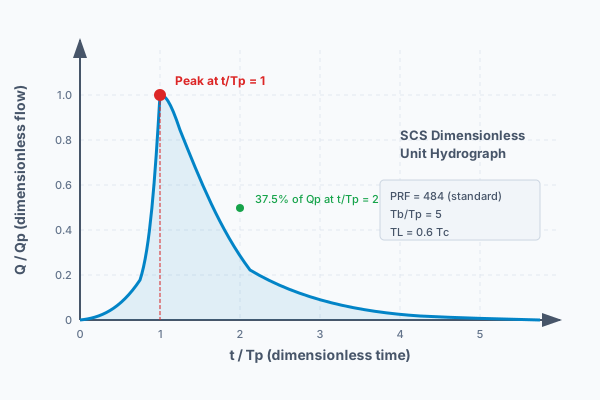
Key Relationships
Peak flow:
Where:
- Qp = Peak discharge (cfs)
- A = Drainage area (mi²)
- Q = Runoff depth (inches)
- Tp = Time to peak (hours)
Time to peak:
Where:
- D = Duration of unit excess rainfall
- TL = Lag time ≈ 0.6 × Tc
Hydrograph Modification Through Routing
As a hydrograph moves through a channel or storage facility, it changes shape:
Channel Routing Effects
- Peak attenuates (gets lower)
- Peak arrives later (translation)
- Hydrograph spreads out (diffusion)
- Volume is conserved (what goes in must come out)
Storage Routing Effects
- Significant peak reduction
- Time delay
- Volume conserved but released slower
Try the Muskingum Routing Calculator →
Combining Hydrographs
When multiple tributaries combine, their hydrographs add together. However, if peaks don’t occur simultaneously, the combined peak may be less than the sum of individual peaks.
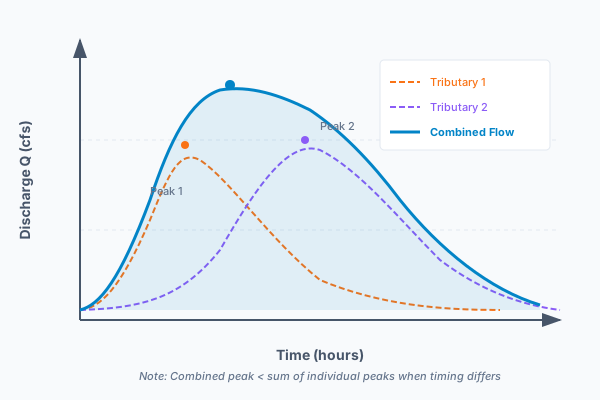
Convolution
For complex storms with varying intensity, hydrographs are combined using convolution:
This sums the unit hydrograph responses to each time step of rainfall, offset appropriately.
Try the Hydrograph Convolution Calculator →
Practical Applications
Detention Pond Sizing
Hydrographs are essential for detention pond design because:
- Inflow hydrograph determines how much water arrives and when
- Outflow hydrograph must meet peak flow restrictions
- Stored volume is the difference between cumulative inflow and outflow
Flood Analysis
Hydrographs help predict:
- Peak flood stage
- Duration of flooding
- Warning time available
- Volume of floodwater
Environmental Assessment
Flow duration and timing matter for:
- Aquatic habitat
- Sediment transport
- Water temperature
- Downstream erosion
Common Mistakes to Avoid
-
Confusing lag time and time to peak: These are related but different parameters
-
Ignoring base flow: For large events, base flow is negligible, but for small storms it matters
-
Over-smoothing: Real hydrographs have irregular shapes; don’t over-interpret perfect curves
-
Assuming linear superposition always applies: Very large floods may not behave linearly
-
Ignoring timing: Peak flows from different areas may not coincide—don’t just add peaks
Summary
Hydrographs provide a complete picture of watershed response that peak flow alone cannot. Understanding how to read and interpret hydrographs is essential for:
- Detention pond design
- Flood forecasting
- Environmental flow analysis
- Complex drainage system design
Next Steps
- Learn unit hydrograph methods - SCS Unit Hydrograph Calculator
- Practice hydrograph routing - Muskingum Routing Calculator
- Understand curve numbers - Curve Number Method Explained
References
-
Natural Resources Conservation Service. (2007). National Engineering Handbook, Part 630: Hydrology. U.S. Department of Agriculture.
-
Chow, V. T., Maidment, D. R., & Mays, L. W. (1988). Applied hydrology. McGraw-Hill.
-
McCuen, R. H. (2016). Hydrologic analysis and design (4th ed.). Pearson.
-
Bedient, P. B., Huber, W. C., & Vieux, B. E. (2018). Hydrology and floodplain analysis (6th ed.). Pearson.
-
American Society of Civil Engineers. (1996). Hydrology handbook (2nd ed., ASCE Manual of Practice No. 28). ASCE Press.
Try These Calculators
Put what you've learned into practice with these free calculators.
Pond Sizing Calculator
Calculate preliminary detention pond storage requirements using the Modified Rational Method.
Level Pool Routing Calculator
Route inflow hydrographs through detention basins and reservoirs using the Modified Puls (Storage-Indication) method.
SCS Unit Hydrograph Calculator
Calculate peak discharge and generate storm hydrographs using the SCS/NRCS dimensionless unit hydrograph method.
SCS Triangular Hydrograph Calculator
Generate SCS triangular unit hydrographs for simplified runoff analysis.
Hydrograph Convolution Calculator
Calculate runoff hydrographs using unit hydrograph convolution.
Muskingum Routing Calculator
Route flood hydrographs through channel reaches using the Muskingum method.