A French drain is one of the most effective, time-tested drainage solutions available to homeowners. Despite the name, it has nothing to do with France. The system is named after Henry Flagg French, a Massachusetts farmer who popularized the technique in his 1859 book on farm drainage. Today, French drains are used everywhere from residential backyards to highway construction.
This guide covers everything you need to know about French drains: how they work, where to install them, what materials to use, and step-by-step instructions for doing it yourself.
How a French Drain Works
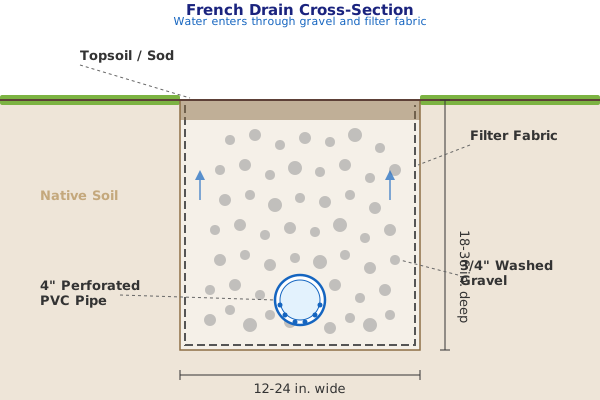
A French drain is remarkably simple. You dig a trench, line it with filter fabric, fill it with gravel, and lay a perforated pipe in the gravel. Water from the surrounding soil enters the trench, passes through the gravel, enters the pipe through its perforations, and flows by gravity to a discharge point at a lower elevation.
The key principle is that water always takes the path of least resistance. Gravel is much more permeable than the surrounding soil, so water moves preferentially into the gravel-filled trench rather than staying in the saturated ground. The perforated pipe then collects and transports this water efficiently.
Key Components
Perforated pipe. Typically 4-inch diameter for residential applications. Rigid PVC Schedule 40 with drilled holes is the gold standard for longevity. Flexible corrugated pipe is cheaper but more prone to crushing, clogging, and root intrusion. If you are investing the labor to dig a trench, spend the extra money on rigid pipe.
Gravel. Clean, washed stone in the 3/4-inch to 1-1/2-inch range. Avoid limestone in acidite areas because it dissolves over time. River rock or crushed granite are excellent choices. You need enough gravel to surround the pipe on all sides with at least 3 inches of coverage.
Filter fabric. Nonwoven geotextile fabric that allows water to pass through while keeping fine soil particles out of the gravel. Without filter fabric, fine particles (especially from clay soil) will gradually migrate into the gravel and clog the system. This is the most commonly skipped step and the number-one reason French drains fail.
Trench dimensions. A typical residential French drain trench is 12 inches wide and 18 to 24 inches deep. The French Drain Calculator can help you determine the right dimensions based on your specific drainage area and soil conditions.
Where to Install a French Drain
French drains work best in these situations:
- Along the base of a slope where water seeps out of a hillside
- Around a foundation to intercept groundwater before it reaches the basement (called a “curtain drain” or “footing drain”)
- Across a yard to intercept sheet flow and redirect it away from structures
- Along a driveway or property boundary to prevent water from crossing onto your property
They do not work well for collecting surface water from paved areas (use a catch basin or trench drain for that) or in areas where the water table is above the bottom of the trench (the pipe would be submerged and unable to drain).
Step-by-Step Installation
Materials Needed
- Perforated PVC pipe (4-inch diameter, enough for the full run plus fittings)
- Clean washed gravel (calculate roughly 1.5 tons per 10 linear feet for a 12x18 inch trench)
- Nonwoven geotextile filter fabric (roll wide enough to wrap the full trench)
- Solid PVC pipe and fittings for the discharge end
- PVC cement and primer
- Pop-up emitter or other discharge fitting
- Stakes and string line
Step 1: Plan Your Route
Map out the trench from the problem area to your discharge point. The drain needs a continuous downhill slope of at least 1 percent (1/8 inch per foot). Use a string line and level to establish the grade. Mark the route with landscape paint or stakes.
Call 811 before you dig. Wait for utility locators to mark all underground lines. This is free, required by law in all 50 states, and could save your life.
Step 2: Dig the Trench
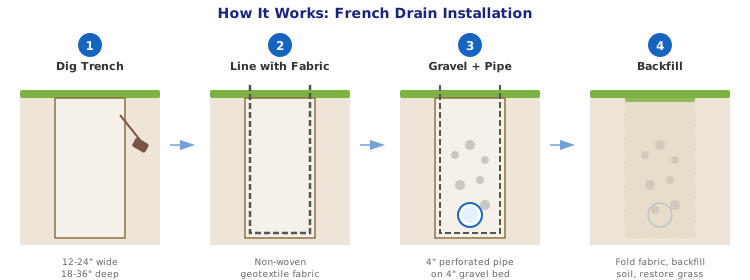
Dig the trench 12 inches wide and 18 to 24 inches deep. Maintain a consistent slope by checking with a level as you go. The bottom of the trench should be smooth and free of rocks or roots that could puncture the fabric or misalign the pipe.
For trenches over 50 feet, consider renting a trenching machine. Hand-digging is feasible but extremely labor-intensive.
Step 3: Line with Filter Fabric
Roll out the geotextile fabric along the length of the trench, with enough excess on each side to fold over the top of the gravel later. The fabric should line the bottom and both sides of the trench.
Step 4: Add Base Gravel and Pipe
Shovel 2 to 3 inches of gravel into the bottom of the trench. Place the perforated pipe on top, with the holes facing down (this is debated, but holes-down allows the pipe to fill before water enters, preventing sediment from settling in the pipe). Connect pipe sections with couplings and PVC cement.
At the discharge end, transition from perforated pipe to solid pipe so water does not leak out before reaching the outlet.
Step 5: Fill with Gravel
Fill the trench with gravel to within 3 to 4 inches of the surface. The pipe should be completely buried in gravel with at least 3 inches of coverage on top.
Step 6: Wrap and Backfill
Fold the excess filter fabric over the top of the gravel, overlapping at least 6 inches. This creates a complete envelope that keeps soil particles out of the gravel. Cover with topsoil and seed, sod, or mulch.
Step 7: Install the Outlet
At the discharge end, install a pop-up emitter, connect to a storm drain (if permitted), or daylight the pipe at a lower elevation. The outlet should be positioned so water flows away from any structures.
Common Mistakes to Avoid
Skipping the filter fabric. The number-one cause of French drain failure. Without fabric, fine soil particles clog the gravel within 2 to 5 years.
Using the wrong gravel. Pea gravel and sand are too fine. Dirty gravel with fines will clog. Use clean, washed 3/4-inch to 1-1/2-inch stone only.
Insufficient slope. A flat or nearly flat French drain will not work. Maintain at least 1 percent slope (1/8 inch per foot) from start to finish.
Using flexible corrugated pipe. It is tempting because it is cheap and easy to work with. But it crushes under soil weight, the corrugations trap sediment, and tree roots love to invade the ridges. Use rigid PVC for any drain you want to last more than a few years.
No discharge point. A French drain must have somewhere to send the water. If the pipe just ends underground, water will back up and the system will fail.
Undersizing the trench. A 6-inch-wide trench with a 4-inch pipe leaves almost no gravel around the pipe. The minimum practical width is 12 inches.
Maintenance
French drains are low-maintenance but not no-maintenance:
- Annually: Check the discharge outlet for blockages. Clear any debris from pop-up emitters.
- Every 2-3 years: Flush the pipe with a garden hose from a cleanout fitting (install one at the upstream end if possible).
- Every 5-10 years: Inspect the system performance. If drainage is noticeably slower, the gravel or fabric may need attention.
- Keep trees and large shrubs at least 10 feet from the trench. Roots are the enemy of French drains.
Cost Breakdown
| Item | DIY Cost | Professional Cost |
|---|---|---|
| Perforated PVC pipe (4”) | $1-2/ft | Included |
| Washed gravel | $3-5/ft | Included |
| Geotextile fabric | $0.50-1/ft | Included |
| Fittings and connectors | $20-50 total | Included |
| Equipment rental | $100-300 | Included |
| Total per linear foot | $8-15/ft | $15-30/ft |
A typical 50-foot residential French drain costs $400 to $750 for DIY or $750 to $1,500 installed professionally.
When to Call a Professional
- You need to connect to the municipal storm drain system (permits and inspections required)
- The drain needs to go under a driveway, sidewalk, or other hardscape
- You are dealing with foundation drainage and basement waterproofing
- The trench needs to be deeper than 3 feet (safety concern)
- The slope of your yard requires engineered grading before the drain can work
Size Your French Drain
Use the French Drain Calculator to determine the right pipe size, trench dimensions, and gravel volume for your specific project. Enter your drainage area, soil type, and slope, and the calculator does the rest.
Related Calculators
- French Drain Calculator — Size your French drain
- Rational Method Calculator — Estimate peak runoff
- Dry Well Calculator — Alternative infiltration solution
- Foundation Drain Calculator — Foundation-specific drainage