Water and driveways do not get along. Water erodes the base material under asphalt, causes concrete to crack and heave, and turns gravel driveways into muddy ruts. If water pools on or near your driveway, you need a drainage solution before the damage gets expensive.
This guide covers the three most common driveway drainage solutions: trench drains, channel drains, and catch basins. We will explain when each makes sense, what they cost, and how to size them properly.
The Problem with Driveway Water
Driveways are impervious surfaces. Every drop of rain that lands on them runs off immediately. If the driveway slopes toward your garage, house, or a low spot, that water concentrates and causes problems. Common symptoms include:
- Water flowing into the garage under the door
- Puddles that take hours to drain after a rain
- Erosion at the edges of the driveway
- Ice formation in winter at consistent low spots
- Basement flooding from water channeled along the driveway
Solution 1: Trench Drains (Channel Drains)
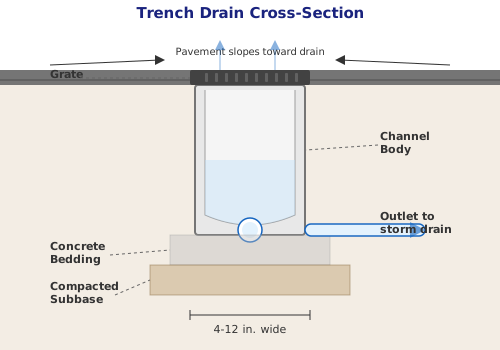
A trench drain, also called a channel drain, is a long, narrow drain set into the driveway surface. It consists of a U-shaped channel with a grate on top. Water flows across the driveway surface, drops through the grate, and is carried away through the channel to an underground pipe.
Best for: Intercepting sheet flow across the full width of a driveway. The most common placement is across the driveway at the garage entrance.
How it works: The channel is set into a concrete or asphalt saw-cut, typically flush with the surface. The grate must be rated for the expected traffic load (pedestrian, residential vehicle, or commercial).
Sizing: The channel must be large enough to carry the peak flow from the contributing area. A standard 4-inch-wide channel can handle up to about 0.5 acres of drainage at moderate slopes. Use the Trench Drain Calculator to determine the right size.
Cost: $15 to $30 per linear foot for the drain body and grate, plus $20 to $50 per foot for installation. A typical 20-foot driveway crossing costs $700 to $1,600 installed.
Solution 2: Catch Basins
A catch basin is a rectangular box with a grated top, installed at a low point where water collects. Water drops through the grate into the box, which connects to an underground pipe that carries it to a discharge point.
Best for: Specific low spots where water pools. A single catch basin at the low point of a driveway can solve a ponding problem.
How it works: The catch basin includes a sump (a few inches below the outlet pipe) that traps sediment and debris. The outlet pipe connects to a storm drain, French drain, or daylight outlet.
Sizing: Catch basins come in various sizes (9x9, 12x12, 18x18 inches). The grate opening must be large enough to accept the incoming flow without water backing up around it. The outlet pipe (typically 4 to 6 inches) must be sized to handle the full flow. Use the Catch Basin Calculator for proper sizing.
Cost: $150 to $400 per catch basin (materials), plus $300 to $800 for installation including underground piping.
Solution 3: Swales and Berms
For driveways that channel water across a yard, a shallow swale (grass-lined channel) along the edge of the driveway can intercept and redirect flow. A berm (raised earth ridge) on the downhill side of the driveway prevents water from leaving the paved surface at undesired locations.
Best for: Rural or suburban driveways with adjacent lawn areas where aesthetics matter and flows are moderate.
Cost: $5 to $15 per linear foot (mostly labor for grading).
Use the Vegetated Swale Calculator to size a swale for your driveway.
Choosing the Right Solution
| Situation | Best Solution |
|---|---|
| Water flows into garage | Trench drain across driveway at garage entrance |
| Specific low spot pools water | Catch basin at the low point |
| Water runs down a sloped driveway | Trench drain at the base of the slope |
| Water crosses from driveway to yard | Swale along driveway edge |
| Water enters from neighbor’s property | Berm + swale at property line |
Installation Considerations
Slope matters. All underground pipes must slope at least 1 percent (1/8 inch per foot) toward the discharge point. Flat or backsloping pipes will clog and fail. Use the Drainage Fall Calculator to convert a target slope into the exact drop over your pipe run.
Grate strength matters. Residential driveways need grates rated for at least 2,000 pounds (Class A). If delivery trucks or heavy vehicles will cross the drain, you need a Class C or higher rating.
Freeze-thaw cycles. In cold climates, choose drain materials and installation methods that accommodate freeze-thaw. Polymer concrete channels resist cracking better than standard concrete.
Permits. Check with your local building department. Many jurisdictions require permits for driveway drainage work, especially if connecting to the storm drain system.
When to Call a Professional
- The driveway needs to be saw-cut to install a trench drain (specialized equipment)
- You need to connect to a municipal storm drain
- The drainage area exceeds 5,000 square feet
- The driveway is on a steep slope where flows could be dangerous during storms
- Multiple solutions need to work together as a system
Related Calculators
- Trench Drain Calculator — Size channel drains for driveways
- Catch Basin Calculator — Size point drainage inlets
- Vegetated Swale Calculator — Design grass-lined drainage channels
- Rational Method Calculator — Estimate peak runoff from paved surfaces
- Drainage Fall Calculator — Convert pipe slope into total fall over a run